Birds That Exist Here — But Are Never Guaranteed
Chiang Dao is well known among birdwatchers for its mountain forests, river habitats, and rich biodiversity.
But when people hear the phrase “rare birds,” they often imagine extremely difficult species or accidental migrants.
For me, “rare birds in Chiang Dao” has a slightly different meaning.
These are birds that genuinely occur in the area, but are seen only occasionally, unpredictably, or in very low density. Some of them may actually be easier target birds in other birding locations in Thailand — but in Chiang Dao, encounters are far less consistent.
That uncertainty is part of what makes birding here exciting.
Sometimes you can spend many days without seeing them.
Sometimes they suddenly appear for only a few seconds.
This article is based on my personal field experience as a local birding guide in Chiang Dao.
👉 Explore more: Chiang Dao Birding Guide
👉 Read also: Target Birds in Chiang Dao
👉 Discover habitats: Birding Locations in Chiang Dao
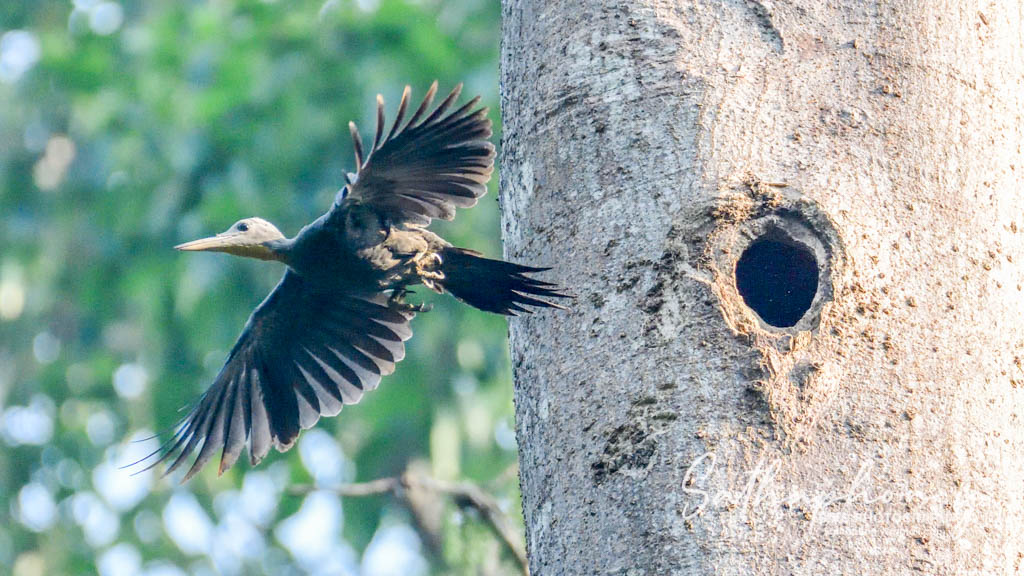
1. Great Slaty Woodpecker
The Giant Ghost of the Forest
Great Slaty Woodpecker
The Great Slaty Woodpecker is one of the most unforgettable birds you can encounter in Chiang Dao.
Massive, noisy, and usually travelling in active family groups, this species can suddenly turn a quiet forest into chaos. Their loud calls and powerful movements through dead trees are impossible to ignore.
Yet despite their size, sightings in Chiang Dao remain unpredictable.
In some birding locations in Southeast Asia, this species may be relatively reliable.
But here, it often feels like a reward for patience and luck.
Why It’s Special in Chiang Dao
- Very low encounter frequency
- Requires mature forest habitat
- Often appears briefly before disappearing again
- Memorable sound and behaviour
2. Black-headed Woodpecker
A Difficult Woodpecker in Chiang Dao
Black-headed Woodpecker
The Black-headed Woodpecker is one of those birds that many visiting birders know well from other northern Thailand locations — but in Chiang Dao, it is much less predictable.
This species usually prefers quieter forest edges and mixed woodland habitats.
Often the first clue is not visual, but sound.
Like many woodpeckers, encounters are often brief, high in trees, and dependent on timing.
Field Experience
- Usually detected by call first
- Can disappear quickly into canopy cover
- Easier in some nearby mountain areas than Chiang Dao itself
3. Rusty-naped Pitta
A Secretive Jewel of the Forest Floor
Rusty-naped Pitta
The Rusty-naped Pitta is one of Chiang Dao’s true hidden treasures.
This is not a bird you casually encounter while walking through the forest.
It requires patience, quiet conditions, and a little luck.
Like many pittas, it prefers dense forest floor habitat where visibility is limited. Most encounters are short and unforgettable.
For photographers, even a few seconds can feel incredibly rewarding.
Why Birders Search for It
- Beautiful forest-floor species
- Extremely shy behaviour
- Rarely seen in open view
- A special reward for patient birders
👉 Related article: Why Chiang Dao is Special for Birding
4. Blyth’s Frogmouth
The Sound You Hear Before You See
Blyth’s Frogmouth
Blyth’s Frogmouth is one of the most mysterious night birds in Chiang Dao.
Many people hear it long before they ever see it.
Its camouflage is extraordinary, blending perfectly with branches and dead wood. Even when the bird is directly in front of you, it can remain almost invisible.
Night birding in Chiang Dao always carries uncertainty, and that is exactly what makes species like this so exciting.
Best Conditions
- Quiet forest nights
- Experienced local knowledge helps significantly
- Calm weather improves listening conditions
👉 Explore more: Night Birding in Chiang Dao
5. Blue-eared Kingfisher
A Flash of Colour Along Forest Streams
Blue-eared Kingfisher
The Blue-eared Kingfisher is one of the most beautiful stream birds in Chiang Dao, but sightings are never guaranteed.
Unlike the larger and easier-to-detect river kingfishers, this species can appear suddenly as a small flash of electric blue flying low above water.
Dense streamside vegetation often makes observation difficult.
Why It Feels Rare Here
- Fast movement through shaded streams
- Sensitive to disturbance
- Often seen only briefly
- Requires quiet stream habitat
6. Banded Kingfisher
A Forest Kingfisher Few People Forget
Banded Kingfisher
The Banded Kingfisher is one of the most exciting and unpredictable birds in Chiang Dao forests.
Unlike open-river kingfishers, this species is deeply connected to forest habitats.
Its behaviour is secretive, and encounters often happen unexpectedly.
Some birders visit Chiang Dao for many years without seeing one. Others encounter it suddenly during ordinary forest walks.
That uncertainty is part of the experience.
What Makes It Special
- Stunning colours and unique pattern
- Forest-dependent kingfisher
- Naturally shy behaviour
- Highly memorable encounter
Rare Does Not Always Mean Impossible
Birding in Chiang Dao is not only about chasing rarity.
It is about understanding habitat, timing, weather, and behaviour.
Some of these birds may be easier targets in other provinces or mountain ranges.
But in Chiang Dao, they remain genuinely special encounters — birds you remember long after the trip ends.
That is what “rare birds in Chiang Dao” means to me.